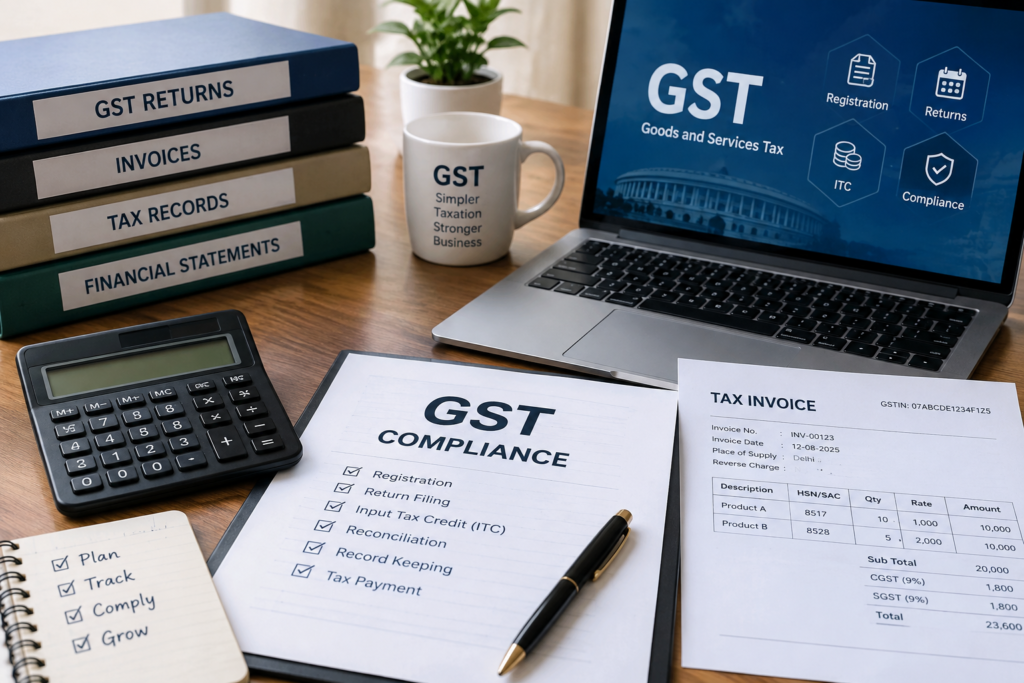
GST in India 2026: Complete Guide to Goods and Services Tax Compliance in Delhi
The Goods and Services Tax (GST) is one of the most significant tax reforms introduced in India, bringing multiple indirect taxes under a unified taxation system. Since its implementation, GST has simplified the tax structure for businesses, improved transparency, and enhanced tax compliance across industries. Whether you are a startup, small business owner, trader, manufacturer, service provider, or large corporation, understanding GST regulations is crucial for smooth business operations.

In 2026, GST compliance continues to be a key responsibility for businesses operating across India. Companies in Delhi, one of the country’s largest commercial and business hubs, must ensure proper GST registration, return filing, invoicing, and tax payment to avoid penalties and legal complications. Professional GST consulting services help businesses remain compliant while maximizing tax efficiency.

What is GST?

Goods and Services Tax (GST) is an indirect tax levied on the supply of goods and services in India. It replaced multiple indirect taxes such as VAT, service tax, excise duty, entry tax, and several state-level taxes.

GST follows a destination-based taxation system, meaning the tax revenue is collected by the state where goods or services are consumed rather than where they are produced.

The GST framework consists of:

  • Central GST (CGST)
  • State GST (SGST)
  • Integrated GST (IGST)
  • Union Territory GST (UTGST)

The objective of GST is to create a unified national market and simplify tax administration.

Importance of GST for Businesses

GST plays a vital role in India’s economy by promoting transparency and reducing tax cascading.

Key benefits include:

Simplified Tax Structure

Businesses deal with a single tax framework instead of multiple indirect taxes.

Input Tax Credit (ITC)

GST allows businesses to claim credit for taxes paid on purchases, reducing the overall tax burden.

Improved Compliance

The digital GST system improves transparency and minimizes tax evasion.

Enhanced Business Efficiency

Standardized procedures simplify interstate trade and business operations.

Better Record Keeping

GST encourages systematic accounting and documentation practices.

Who Needs GST Registration?

GST registration is mandatory for businesses that meet prescribed turnover thresholds or engage in certain specified activities.

Businesses typically requiring GST registration include:

  • Manufacturers
  • Traders
  • Service providers
  • E-commerce sellers
  • Online businesses
  • Interstate suppliers
  • Importers and exporters

Voluntary registration may also benefit businesses seeking input tax credits and enhanced credibility.

GST Registration Process

The GST registration process is primarily conducted online.

Step 1: Documentation Preparation

Required documents may include:

  • PAN card
  • Aadhaar card
  • Business registration certificate
  • Address proof
  • Bank account details
  • Photographs of promoters or directors

Step 2: Application Submission

The registration application is filed through the GST portal.

Step 3: Verification

Authorities verify the information and supporting documents.

Step 4: GSTIN Allotment

Upon approval, the business receives a GST Identification Number (GSTIN).

Proper registration is essential before commencing taxable business activities.

GST Return Filing

GST-registered businesses must regularly file returns reporting sales, purchases, tax collected, and tax paid.

Common GST returns include:

GSTR-1

Details of outward supplies and sales transactions.

GSTR-3B

Summary return containing tax liability and payment details.

Annual Return

Comprehensive summary of annual GST activities.

Timely filing helps businesses avoid penalties and maintain compliance.

Input Tax Credit (ITC)

Input Tax Credit is one of the most significant benefits of GST.

Businesses can claim credit for GST paid on:

  • Raw materials
  • Goods purchased for resale
  • Business services
  • Capital goods
  • Operational expenses

Benefits of ITC

  • Reduces tax liability
  • Improves cash flow
  • Prevents tax cascading
  • Encourages compliance

Proper documentation and invoice management are essential for claiming ITC successfully.

GST Compliance Requirements

Maintaining GST compliance involves more than registration and return filing.

Businesses must ensure:

Accurate Invoicing

GST-compliant invoices should include:

  • GSTIN
  • Invoice number
  • Date of issue
  • Taxable value
  • Applicable GST rates

Record Maintenance

Proper books of accounts and supporting documents must be maintained for prescribed periods.

Tax Payment

Businesses must deposit GST liabilities within specified deadlines.

Reconciliation

Regular reconciliation of invoices, returns, and accounting records helps prevent discrepancies.

Common GST Challenges Faced by Businesses

Many businesses encounter challenges in managing GST compliance.

Common issues include:

Incorrect Return Filing

Errors in GST returns can result in notices and penalties.

Input Tax Credit Mismatches

Invoice mismatches may lead to denial of ITC claims.

Classification Disputes

Incorrect classification of goods or services can affect tax rates.

Delayed Compliance

Late filing and tax payments attract interest and penalties.

GST Audits

Businesses may face scrutiny and audits by tax authorities.

Professional GST consultants help address these challenges effectively.

GST for Startups and Small Businesses

Startups and SMEs in Delhi often benefit significantly from GST registration and compliance.

Advantages include:

  • Enhanced business credibility
  • Access to larger markets
  • Eligibility for input tax credits
  • Improved financial management
  • Better opportunities for corporate contracts

Early compliance helps startups avoid future legal and tax complications.

GST for E-Commerce Businesses

The growth of online commerce has increased the importance of GST compliance.

E-commerce sellers must manage:

  • GST registration requirements
  • Marketplace compliance
  • Tax collection at source (TCS)
  • Interstate transactions
  • Digital invoicing

Professional guidance helps online businesses remain compliant while focusing on growth.

GST Audit and Assessment

GST authorities may conduct audits and assessments to verify compliance.

During audits, officials review:

  • Books of accounts
  • Tax invoices
  • Return filings
  • Input tax credit claims
  • Business transactions

Proper record keeping and professional support significantly reduce audit-related risks.

GST Litigation and Dispute Resolution

Businesses may face GST-related disputes involving:

  • Tax demands
  • Penalties
  • ITC disallowances
  • Classification issues
  • Registration cancellations

Experienced GST professionals and tax lawyers assist in:

  • Replying to notices
  • Filing appeals
  • Representation before authorities
  • Tribunal proceedings
  • Legal advisory services

Timely legal intervention often leads to more favorable outcomes.

Why Choose Professional GST Services in Delhi?

Delhi is home to a diverse business ecosystem comprising startups, traders, manufacturers, service providers, and multinational corporations. Managing GST compliance requires expertise, accuracy, and continuous monitoring of regulatory changes.

Professional GST consultants provide:

  • GST registration assistance
  • Return filing support
  • Input tax credit management
  • GST audits
  • Compliance reviews
  • Tax planning
  • Notice handling
  • Litigation support

Expert guidance helps businesses minimize risks and focus on growth opportunities.

Conclusion

GST continues to be a cornerstone of India’s indirect taxation system in 2026. While it has simplified taxation and improved transparency, businesses must remain vigilant about compliance requirements. Proper registration, accurate return filing, input tax credit management, and timely tax payments are essential for avoiding penalties and maintaining smooth operations.

For businesses operating in Delhi, professional GST services provide valuable support in navigating complex tax regulations and ensuring full compliance. Whether you are a startup, SME, trader, manufacturer, or large corporation, proactive GST management contributes significantly to financial stability and long-term business success.


GST in India: Understanding Goods and Services Tax and Its Business Impact
GST: Understanding Goods and Services Tax, Compliance, and Business Benefits

Goods and Services Tax (GST) is one of the most significant tax reforms introduced in India to simplify the indirect taxation system. Implemented on 1st July 2017, GST replaced multiple indirect taxes such as VAT, Service Tax, Excise Duty, Central Sales Tax, and several state-level taxes. The primary objective of GST is to create a unified tax structure across the country, improve transparency, reduce tax cascading, and promote ease of doing business.

GST applies to the supply of goods and services throughout India and affects businesses of all sizes, including manufacturers, traders, service providers, e-commerce companies, startups, and professionals. Proper GST compliance has become essential for smooth business operations, legal protection, and financial management.

What is GST?

GST is a destination-based indirect tax levied on the consumption of goods and services. It is collected at every stage of the supply chain, but the burden ultimately falls on the final consumer.

Under GST, businesses can claim Input Tax Credit (ITC), which helps eliminate the cascading effect of taxes and ensures that tax is charged only on value addition.

GST has transformed India’s tax structure into a more transparent and technology-driven system.

Objectives of GST

The GST system was introduced to achieve several economic and administrative goals, including:

  • Creating a unified national market
  • Eliminating multiple indirect taxes
  • Reducing tax evasion
  • Improving tax compliance
  • Simplifying business operations
  • Encouraging economic growth
  • Enhancing transparency in taxation
  • Reducing the cascading effect of taxes

GST has significantly modernized India’s taxation framework.

Types of GST in India

CGST (Central Goods and Services Tax)

Collected by the Central Government on intra-state transactions.

SGST (State Goods and Services Tax)

Collected by State Governments on intra-state transactions.

IGST (Integrated Goods and Services Tax)

Applicable to inter-state supply of goods and services.

UTGST (Union Territory Goods and Services Tax)

Applicable in Union Territories without legislatures.

Understanding the different types of GST is important for accurate tax compliance.

GST Registration

Businesses whose turnover exceeds prescribed limits are required to obtain GST registration.

GST registration is mandatory for:

  • Businesses crossing turnover thresholds
  • E-commerce sellers
  • Interstate suppliers
  • Online service providers
  • Certain professionals and consultants
  • Casual taxable persons
  • Input service distributors

After registration, businesses receive a GST Identification Number (GSTIN).

Benefits of GST Registration

GST registration offers several advantages, including:

  • Legal recognition as a supplier
  • Eligibility for Input Tax Credit
  • Improved business credibility
  • Nationwide tax compliance
  • Easier interstate trade
  • Better transparency in transactions
  • Participation in government tenders

Registered businesses also gain greater trust among customers and vendors.

Input Tax Credit (ITC)

Input Tax Credit is one of the most important features of GST. It allows businesses to claim credit for GST paid on purchases and business expenses.

For example, if a business pays GST on raw materials or services, it can adjust that amount against GST liability on sales.

ITC helps:

  • Reduce overall tax burden
  • Prevent double taxation
  • Improve cash flow management
  • Encourage proper invoicing and compliance

However, ITC claims require accurate documentation and compliance with GST rules.

GST Returns

GST-registered businesses must regularly file returns detailing sales, purchases, tax liability, and ITC claims.

Common GST returns include:

  • GSTR-1
  • GSTR-3B
  • Annual Returns
  • Reconciliation Statements

Timely filing is important to avoid penalties, notices, and compliance issues.

GST Compliance for Businesses

GST compliance involves:

  • Proper invoicing
  • Accurate bookkeeping
  • Timely tax payments
  • Return filing
  • E-way bill generation
  • Record maintenance
  • Vendor compliance verification

Non-compliance can result in penalties, interest, registration cancellation, or legal proceedings.

E-Way Bill System

The E-Way Bill system is used for tracking movement of goods above prescribed values.

It includes details such as:

  • Supplier information
  • Recipient details
  • Invoice value
  • Transport details
  • Goods description

E-Way Bills help authorities monitor goods movement and reduce tax evasion.

GST for Service Providers

Service providers such as consultants, freelancers, agencies, legal professionals, IT companies, and digital marketers are also covered under GST.

GST on services varies depending on the category of service provided. Service providers must ensure proper invoicing, tax collection, and return filing.

GST for E-Commerce Businesses

Online sellers and e-commerce operators have specific GST compliance obligations.

E-commerce GST compliance may include:

  • Tax collection at source (TCS)
  • Mandatory registration
  • Marketplace reporting requirements
  • Interstate transaction compliance

Digital businesses must carefully manage GST obligations to avoid regulatory complications.

GST Audits and Investigations

GST authorities may conduct audits, inspections, and investigations to verify compliance.

Common issues investigated include:

  • Fake invoicing
  • Wrong ITC claims
  • Tax evasion
  • Non-filing of returns
  • Mismatch in invoices
  • Fraudulent transactions

Businesses facing GST notices or investigations should seek professional legal and tax advice immediately.

GST Litigation and Disputes

GST disputes may arise regarding:

  • Classification of goods and services
  • Tax rates
  • ITC denial
  • Registration cancellation
  • Refund rejection
  • Penalty proceedings
  • E-way bill violations

Tax professionals and GST lawyers help businesses defend their rights and resolve disputes effectively.

Penalties Under GST

Non-compliance with GST laws may lead to:

  • Monetary penalties
  • Interest liabilities
  • Cancellation of registration
  • Seizure of goods
  • Prosecution in serious cases

Maintaining accurate records and timely compliance helps avoid legal complications.

Advantages of GST

Simplified Tax Structure

GST replaced multiple indirect taxes with a unified taxation system.

Elimination of Cascading Tax

Input Tax Credit reduces tax-on-tax effects.

Improved Transparency

Digital compliance systems improve accountability.

Ease of Doing Business

Businesses can operate more efficiently across states.

Better Tax Collection

Technology-driven compliance improves government revenue systems.

Challenges Under GST

Despite its advantages, businesses may face challenges such as:

  • Frequent regulatory changes
  • Complex compliance requirements
  • Technical portal issues
  • ITC reconciliation problems
  • Small business adaptation difficulties

Professional tax guidance helps businesses manage these challenges effectively.

Role of GST Consultants and Legal Experts

GST professionals assist businesses with:

  • GST registration
  • Return filing
  • Tax planning
  • Litigation support
  • Audit handling
  • Notice replies
  • Compliance management
  • Business advisory services

Expert guidance helps businesses remain compliant and avoid financial risks.

Future of GST in India

India’s GST system continues to evolve with technological advancements, digital invoicing, AI-based scrutiny systems, and faceless compliance mechanisms. Authorities are focusing on improving transparency, reducing fraud, and simplifying procedures.

As India’s economy grows, GST will continue to play a central role in taxation, business regulation, and economic development.

Conclusion

GST has transformed India’s indirect taxation landscape by introducing a unified, transparent, and technology-driven tax structure. While GST offers several advantages such as simplified taxation, Input Tax Credit benefits, and improved ease of doing business, compliance remains highly important for businesses and professionals.

Proper GST planning, accurate record management, timely return filing, and professional legal assistance are essential for avoiding disputes and ensuring smooth business operations. Businesses that maintain strong GST compliance systems are better positioned for sustainable growth and long-term success.


Goods and Services Tax (GST): A Complete Guide for Businesses in India
Goods and Services Tax (GST): A Complete Guide for Businesses in India


Goods and Services Tax (GST) is one of the most significant tax reforms in India, designed to simplify the indirect taxation system by replacing multiple taxes with a single unified tax. Introduced on 1 July 2017, GST has streamlined the tax structure, improved compliance, and created a common national market.

What is GST?

GST is a destination-based indirect tax levied on the supply of goods and services. It is called “destination-based” because the tax is collected at the point of consumption rather than the point of origin. This ensures that the state where goods or services are consumed receives the tax revenue.

GST replaced various indirect taxes such as VAT, service tax, excise duty, and central sales tax, thereby reducing the cascading effect of taxes (tax on tax).

Legal Framework of GST

GST in India is governed by several laws, the primary one being the Central Goods and Services Tax Act, 2017. Along with this, there are corresponding State GST Acts, Integrated GST (IGST) Act, and Union Territory GST Act.

The implementation and administration of GST are overseen by the Goods and Services Tax Council, which includes representatives from the central and state governments. The council decides tax rates, rules, and policy changes.

Types of GST

GST in India is divided into four main types:

  • CGST (Central GST): Collected by the central government on intra-state transactions
  • SGST (State GST): Collected by the state government on intra-state transactions
  • IGST (Integrated GST): Collected on inter-state transactions and imports
  • UTGST (Union Territory GST): Applicable in union territories

This dual structure ensures a fair distribution of tax revenue between central and state governments.

GST Registration

Businesses whose turnover exceeds the prescribed threshold must register under GST. The registration process is carried out online through the GST portal.

Mandatory registration is required for:

  • Businesses crossing the turnover limit
  • Inter-state suppliers
  • E-commerce operators
  • Input service distributors

Upon registration, businesses receive a unique GST Identification Number (GSTIN), which must be used in all tax-related transactions.

GST Rates Structure

GST follows a multi-rate structure to accommodate different categories of goods and services:

  • 0% (Exempted goods/services)
  • 5% (Essential items)
  • 12% and 18% (Standard rates)
  • 28% (Luxury and sin goods)

This classification ensures that essential goods are taxed at lower rates, while luxury items attract higher taxes.

Input Tax Credit (ITC)

One of the most important features of GST is the Input Tax Credit mechanism. ITC allows businesses to claim credit for the tax paid on inputs used in the production or supply of goods and services.

For example, if a manufacturer pays GST on raw materials, they can deduct that amount from the GST payable on the final product. This eliminates the cascading effect of taxes and reduces the overall tax burden.

GST Returns and Compliance

Registered taxpayers must file periodic GST returns, which include details of sales, purchases, tax collected, and tax paid. Common returns include:

  • GSTR-1 (Outward supplies)
  • GSTR-3B (Monthly summary return)
  • Annual return

Timely filing of returns is essential to avoid penalties and ensure smooth business operations.

Benefits of GST

GST has brought several advantages to the Indian economy:

  • Simplified Tax Structure: Replaced multiple indirect taxes with a single system
  • Elimination of Cascading Effect: Reduced double taxation
  • Ease of Doing Business: Simplified compliance through online systems
  • Uniform Tax Rates: Created a common market across states
  • Increased Transparency: Improved tax compliance and reduced evasion

GST has also encouraged digitization and formalization of the economy.

Challenges under GST

Despite its benefits, GST has faced certain challenges:

  • Complex compliance for small businesses
  • Frequent changes in rules and rates
  • Technical issues with the GST portal
  • Working capital blockage due to delayed ITC refunds

The government continues to address these issues through policy updates and system improvements.

GST for Small Businesses

To support small businesses, the government introduced the Composition Scheme. Under this scheme, eligible businesses can pay GST at a lower fixed rate and file simplified returns. However, they cannot claim input tax credit.

This scheme reduces the compliance burden for small taxpayers and encourages voluntary registration.

GST and Digital Economy

GST has significantly contributed to the digital transformation of India’s tax system. The entire process—from registration to return filing—is conducted online. This has increased efficiency, reduced corruption, and improved record-keeping.

E-invoicing and e-way bills are additional features that enhance transparency and tracking of goods movement.

Importance of GST for Businesses

GST plays a crucial role in business operations:

  • Ensures legal compliance
  • Improves supply chain efficiency
  • Reduces tax costs through ITC
  • Enhances credibility with customers and vendors
  • Facilitates expansion across states

Understanding GST is essential for businesses to remain competitive and compliant.

Conclusion

GST has revolutionized the indirect tax system in India by creating a unified, transparent, and efficient tax structure. While challenges remain, continuous reforms and technological advancements are making GST more business-friendly.

For entrepreneurs, professionals, and businesses, staying updated with GST laws and compliance requirements is essential. A well-managed GST system not only ensures legal compliance but also contributes to long-term business growth and sustainability.