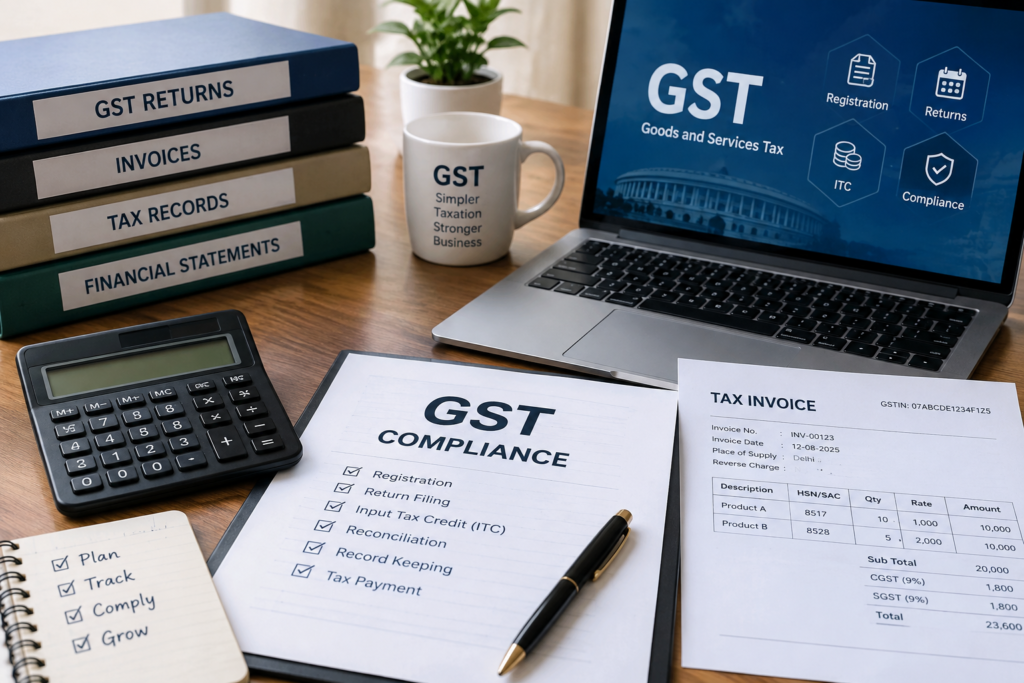
GST in India: Complete Guide to Goods and Services Tax, Registration & Compliance

GST in India: Complete Guide to Goods and Services Tax, Registration & Compliance

Goods and Services Tax (GST) is one of the most significant tax reforms introduced in India. Implemented on 1st July 2017, GST replaced multiple indirect taxes such as VAT, Service Tax, Excise Duty, and Central Sales Tax with a unified tax system. The primary objective of GST is to simplify taxation, improve transparency, reduce tax evasion, and create a common national market.

GST has transformed the Indian taxation structure by introducing a destination-based tax system applicable to the supply of goods and services across the country. Today, GST compliance is essential for businesses, traders, manufacturers, service providers, startups, and e-commerce operators.

Understanding GST laws, registration procedures, return filing, and compliance requirements is crucial for smooth business operations and avoiding penalties.

What is GST?

GST stands for Goods and Services Tax. It is an indirect tax imposed on the supply of goods and services in India. GST is collected at every stage of value addition, but the final tax burden is borne by the end consumer.

GST aims to eliminate the cascading effect of taxes and simplify the overall tax structure in India.

Objectives of GST

The major objectives of GST include:

  • Creating a unified tax system
  • Eliminating multiple indirect taxes
  • Reducing tax evasion
  • Increasing transparency
  • Promoting ease of doing business
  • Enhancing tax compliance
  • Reducing the overall tax burden on consumers

GST has significantly improved the efficiency of India’s taxation and logistics systems.

Types of GST in India

GST in India is divided into different categories depending on the nature of transactions.

1. CGST (Central Goods and Services Tax)

CGST is collected by the Central Government on intra-state transactions.

2. SGST (State Goods and Services Tax)

SGST is collected by the respective State Government on intra-state transactions.

3. IGST (Integrated Goods and Services Tax)

IGST applies to inter-state transactions and imports.

4. UTGST (Union Territory Goods and Services Tax)

UTGST is applicable in Union Territories without legislature.

GST Registration

GST registration is mandatory for businesses crossing the prescribed turnover threshold or engaged in specific activities.

Who Needs GST Registration?

  • Businesses exceeding turnover limits
  • E-commerce sellers
  • Online service providers
  • Interstate suppliers
  • Casual taxable persons
  • Non-resident taxable persons
  • Input service distributors

Benefits of GST Registration

  • Legal recognition as a supplier
  • Ability to collect GST
  • Input tax credit benefits
  • Improved business credibility
  • Expansion across India

Businesses operating without mandatory registration may face penalties and legal consequences.

GSTIN (Goods and Services Tax Identification Number)

After registration, businesses receive a GSTIN, a unique 15-digit identification number used for tax filing and compliance purposes.

GSTIN helps authorities track transactions and maintain tax records efficiently.

GST Rates in India

GST rates are categorized into different slabs depending on the type of goods and services.

Common GST slabs include:

  • 0%
  • 5%
  • 12%
  • 18%
  • 28%

Essential goods are generally taxed at lower rates, while luxury and sin goods attract higher GST rates.

Input Tax Credit (ITC)

One of the biggest advantages of GST is the Input Tax Credit mechanism. Businesses can claim credit for GST paid on purchases and offset it against GST payable on sales.

Benefits of ITC

  • Avoids double taxation
  • Reduces business costs
  • Improves cash flow
  • Encourages tax compliance

To claim ITC, businesses must maintain proper invoices and comply with GST return filing requirements.

GST Returns

GST-registered businesses must regularly file returns to report sales, purchases, tax collected, and tax paid.

Common GST returns include:

  • GSTR-1 – Details of outward supplies
  • GSTR-3B – Summary return and tax payment
  • GSTR-9 – Annual return
  • GSTR-4 – Composition scheme return

Timely filing of returns is necessary to avoid penalties, interest, and notices from tax authorities.

GST Compliance Requirements

Businesses must comply with several GST-related obligations, including:

  • Maintaining proper invoices
  • Filing timely returns
  • Paying taxes on time
  • Preserving accounting records
  • Reconciling input tax credit
  • Generating e-way bills where applicable

Non-compliance may result in:

  • Financial penalties
  • Interest liabilities
  • Cancellation of registration
  • Legal proceedings

Composition Scheme Under GST

The Composition Scheme is a simplified tax scheme designed for small businesses with limited turnover.

Benefits of Composition Scheme

  • Lower tax rates
  • Reduced compliance burden
  • Simplified return filing

However, composition dealers cannot claim input tax credit and face certain operational restrictions.

E-Way Bill System

The e-way bill is an electronic document required for transportation of goods above a specified value.

It helps:

  • Track movement of goods
  • Prevent tax evasion
  • Improve logistics transparency

Businesses involved in transportation and supply chains must comply with e-way bill regulations.

GST for Service Providers

GST also applies to professionals and service providers such as:

  • Consultants
  • Lawyers
  • Chartered accountants
  • Digital marketers
  • IT companies
  • Freelancers

Service providers exceeding the prescribed turnover threshold must obtain GST registration and comply with return filing requirements.

Advantages of GST

Simplified Tax Structure

GST replaced multiple indirect taxes with a single unified system.

Elimination of Cascading Taxes

Input tax credit prevents tax-on-tax effects.

Improved Transparency

Digital filing and invoice matching enhance transparency.

Ease of Doing Business

GST promotes smoother interstate trade and business expansion.

Better Tax Compliance

Online systems improve accountability and reduce tax evasion.

Increased Government Revenue

A broader tax base strengthens public revenue collection.

Challenges Under GST

Despite its benefits, businesses may face certain GST challenges:

  • Complex compliance procedures
  • Frequent law amendments
  • Technical portal issues
  • Input tax credit mismatches
  • Classification disputes
  • Penalties for non-compliance

Professional guidance can help businesses manage GST obligations effectively.

Role of GST Consultants and Tax Professionals

GST consultants and tax professionals assist businesses in:

  • GST registration
  • Return filing
  • Tax planning
  • Compliance management
  • Input tax credit reconciliation
  • Representation before tax authorities
  • GST audits and notices

Expert assistance helps businesses avoid legal complications and maintain smooth operations.

GST Audits and Assessments

Tax authorities may conduct GST audits and assessments to verify compliance and tax accuracy.

Businesses should maintain:

  • Proper invoices
  • Accounting records
  • Purchase and sales registers
  • Tax payment proofs

Proper documentation reduces the risk of disputes and penalties.

Impact of GST on Businesses

GST has significantly influenced businesses across various sectors:

  • Manufacturing
  • Retail
  • E-commerce
  • Logistics
  • Service industries
  • Startups

The unified tax structure has improved operational efficiency and interstate trade opportunities.

Conclusion

GST has revolutionized India’s indirect taxation system by creating a transparent, unified, and technology-driven tax structure. It has simplified tax administration, reduced cascading taxes, and enhanced ease of doing business across the country.

However, GST compliance requires proper understanding of registration procedures, return filing, invoicing, and input tax credit mechanisms. Businesses must stay updated with changing regulations and maintain accurate records to avoid penalties and disputes.

Professional GST consultants and tax experts can help businesses manage compliance effectively and optimize tax planning strategies. With proper implementation and awareness, GST continues to contribute significantly to India’s economic growth and formalization of businesses.


Expert GST Services – Seamless Registration, Accurate Filing, and Complete Compliance for Businesses

startup registration in Noida

Expert GST Services for Seamless Compliance and Business Growth

The introduction of the Goods and Services Tax (GST) has revolutionized India’s indirect taxation system, creating a unified tax structure that spans across industries and sectors. While GST has simplified the tax framework, it also comes with detailed compliance requirements, strict deadlines, and extensive documentation. For businesses, navigating this system can be challenging, making professional GST services essential for smooth operations.

From GST registration to return filing, audits, input tax credit management, and reconciliation, expert services ensure businesses meet regulatory requirements without errors. Accurate and timely compliance not only prevents penalties but also improves business credibility and financial transparency. Companies that leverage professional GST advisory gain a competitive edge by optimizing tax structures, managing cash flow efficiently, and ensuring smooth operations.

Beyond compliance, GST impacts pricing strategies, supply chain management, and overall business planning. Professional guidance helps startups, SMEs, and large enterprises make informed decisions on tax planning, input tax utilization, and financial reporting. By outsourcing GST responsibilities to experts, business owners can focus on growth while ensuring that all statutory obligations are met.

Moreover, staying updated with the latest GST amendments, notifications, and changes in tax rates is crucial. Expert GST consultants monitor regulatory updates, assess their impact on your business, and implement necessary changes proactively. This minimizes risks associated with non-compliance and ensures your business remains audit-ready at all times.

In today’s dynamic business environment, expert GST services are more than a legal necessity—they are a strategic advantage. With the right support, businesses can achieve compliance, reduce risks, streamline tax operations, and enhance financial planning. By integrating GST advisory into overall business strategy, companies can turn compliance obligations into opportunities for operational efficiency and sustainable growth.

Key Benefits of Professional GST Services:

  • Hassle-free GST registration and onboarding

  • Timely and accurate GST return filing

  • Efficient input tax credit management

  • Audit support and reconciliation

  • Expert advisory for tax planning and optimization

  • Monitoring of GST updates and regulatory changes

Investing in professional GST services ensures that compliance is seamless, risks are minimized, and your business remains financially robust and strategically agile.