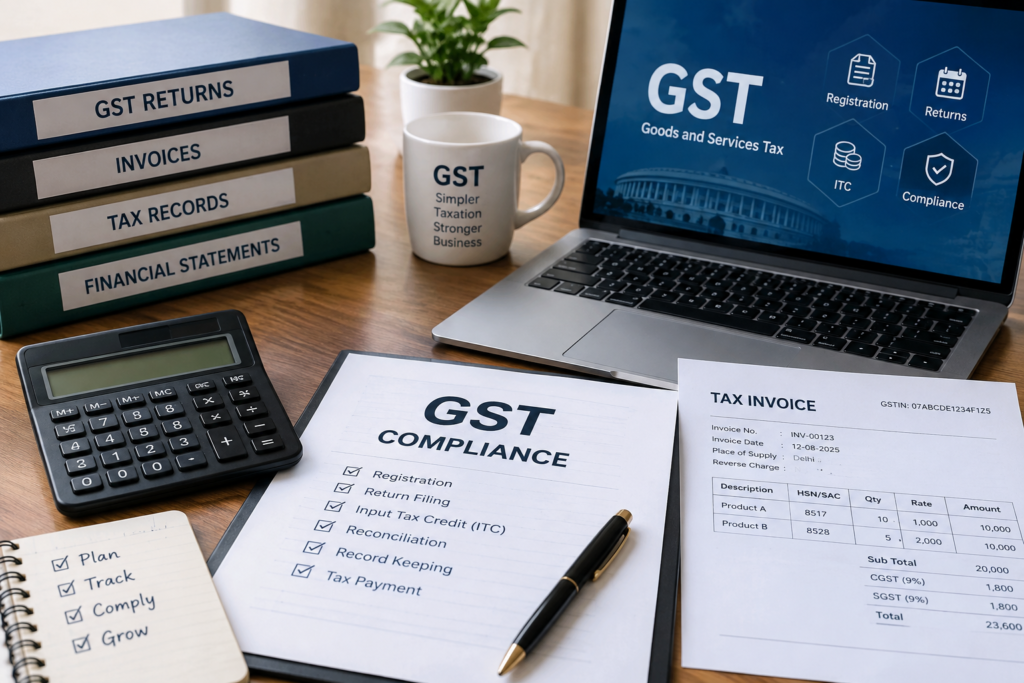
GST (Goods and Services Tax)

GST (Goods and Services Tax)


GST, or Goods and Services Tax, is one of the most significant tax reforms in India. It is a unified indirect tax system introduced to replace multiple indirect taxes such as VAT, service tax, excise duty, and entry tax. GST was implemented to create a single national market, simplify tax compliance, and improve transparency in the taxation system.

In India, GST was introduced on 1 July 2017 under the Goods and Services Tax Act, 2017 and is administered by the Goods and Services Tax Council along with the Central Board of Indirect Taxes and Customs and state tax authorities.

GST applies to the supply of goods and services across the country and has transformed the way businesses manage taxation and compliance.

## What is GST?

GST is a destination-based tax levied on the consumption of goods and services. It means the tax is collected where the goods or services are consumed rather than where they are produced.

It is charged at every stage of the supply chain, but businesses can claim input tax credit for the tax already paid. This avoids the problem of double taxation and reduces the cascading effect of taxes.

GST applies to manufacturers, traders, service providers, e-commerce businesses, and professionals depending on turnover and business activities.

## Types of GST

India follows a dual GST model with different types of GST depending on the nature of the transaction.

### CGST (Central Goods and Services Tax)

CGST is collected by the Central Government on intra-state transactions.

### SGST (State Goods and Services Tax)

SGST is collected by the State Government on the same intra-state transaction.

### IGST (Integrated Goods and Services Tax)

IGST applies to inter-state transactions and imports. It is collected by the Central Government.

### UTGST (Union Territory Goods and Services Tax)

UTGST applies in Union Territories without a legislature.

This structure ensures proper sharing of tax revenue between the central and state governments.

## GST Registration

Businesses whose turnover exceeds the prescribed threshold must register under GST.

GST registration is also required for:

* Interstate suppliers
* E-commerce sellers
* Input service distributors
* Casual taxable persons
* Non-resident taxable persons
* Businesses under reverse charge mechanism
* Certain professionals and service providers

GST registration provides a unique GSTIN (Goods and Services Tax Identification Number) used for tax compliance.

## GST Return Filing

Registered taxpayers must file GST returns regularly.

Common GST returns include:

* GSTR-1 for outward supplies
* GSTR-3B for monthly summary returns
* GSTR-9 for annual return
* GSTR-9C for reconciliation statement in applicable cases

Timely return filing is necessary to avoid late fees, penalties, and compliance notices.

## Input Tax Credit (ITC)

Input Tax Credit is one of the biggest advantages of GST.

It allows businesses to claim credit for the GST paid on purchases used for business purposes. This reduces the final tax burden and improves cash flow.

For example, if a manufacturer pays GST on raw materials, that amount can be adjusted against the GST payable on final product sales.

Proper invoice matching and compliance are necessary for claiming ITC.

## Benefits of GST

GST offers several benefits for businesses and the economy.

### Simplified Tax Structure

It replaces multiple taxes with one unified system.

### Reduced Tax Burden

Input tax credit reduces cascading taxes and overall cost.

### Better Compliance

Digital registration, return filing, and payment systems improve transparency.

### Increased Business Efficiency

Uniform taxation improves interstate trade and business operations.

### Economic Growth

GST supports formalization of the economy and improves tax collection.

## Common GST Issues

Businesses often face challenges such as:

* Registration delays
* Incorrect tax classification
* ITC mismatch
* Late return filing
* GST notices
* Refund delays
* Reverse charge confusion
* E-invoicing compliance issues

Professional guidance helps businesses handle these issues effectively.

## GST Penalties

Non-compliance with GST rules can lead to serious penalties.

Examples include:

* Late filing fees
* Interest on delayed payments
* Penalty for non-registration
* Penalty for false invoicing
* Tax demand notices
* Cancellation of GST registration
* Business audits and investigations

Regular compliance is necessary to avoid financial and legal risks.

## Role of GST Professionals

Chartered accountants, tax consultants, and legal advisors help businesses with:

* GST registration
* Return filing
* Input tax credit management
* GST audits
* Notice handling
* Refund claims
* Litigation and appeals
* Tax planning and advisory

Professional support ensures smooth compliance and reduces legal exposure.

## Conclusion

GST has changed the Indian taxation system by creating a more transparent, efficient, and unified structure for indirect taxes. It benefits businesses through simplified compliance, better tax credit systems, and smoother interstate trade.

However, proper understanding of GST laws, registration requirements, return filing, and compliance responsibilities is essential for avoiding penalties and ensuring business success. Whether for small businesses, startups, or large corporations, GST compliance is a critical part of financial management and legal responsibility.


Income Tax Compliances and Returns in India: A Complete Guide for Individuals and Businesses

Income Tax Compliances and Returns in India: A Complete Guide for Individuals and Businesses

Income Tax Compliances and Returns in India: 

Income tax compliance and return filing are essential responsibilities for every eligible taxpayer in India, whether an individual, professional, or business entity. Proper compliance ensures adherence to legal requirements, avoids penalties, and helps maintain financial transparency. With evolving tax laws and increasing digitalization, understanding income tax regulations has become more important than ever.

This guide provides a comprehensive overview of income tax compliance, the process of filing returns, key requirements, due dates, and best practices for both individuals and businesses in India.

What is Income Tax Compliance?

Income tax compliance refers to the process of fulfilling all legal obligations under the Income Tax Act, 1961. This includes:

  • Filing income tax returns (ITR) on time
  • Paying applicable taxes (advance tax, self-assessment tax, TDS, etc.)
  • Maintaining proper financial records
  • Disclosing income from all sources accurately
  • Following applicable rules and regulations

Compliance ensures that taxpayers report their income correctly and avoid legal consequences such as penalties, interest, or scrutiny.

What is an Income Tax Return (ITR)?

An Income Tax Return (ITR) is a form submitted to the Income Tax Department that contains details of income earned, deductions claimed, and taxes paid during a financial year. Filing an ITR is mandatory for individuals and entities whose income exceeds the prescribed exemption limit or who meet specific conditions under the law.

Who Needs to File Income Tax Returns?

Income tax returns must be filed by:

1. Individuals

  • Salaried employees whose income exceeds the basic exemption limit
  • Individuals with income from multiple sources (salary, rent, capital gains, etc.)
  • Freelancers and self-employed professionals

2. Businesses

  • Companies, partnerships, LLPs, and sole proprietorships
  • Businesses with turnover above specified thresholds
  • Entities required to undergo tax audits

3. Other Entities

  • Trusts, NGOs, and charitable organizations
  • Foreign companies earning income in India
  • Individuals claiming refunds or carrying forward losses

Types of Income Tax Returns (ITR Forms)

The Income Tax Department provides different ITR forms based on the nature of income:

  • ITR-1 (Sahaj): For salaried individuals with income up to a specified limit
  • ITR-2: For individuals with income from capital gains or multiple properties
  • ITR-3: For individuals and professionals with business income
  • ITR-4 (Sugam): For presumptive income under specified schemes
  • ITR-5: For partnership firms and LLPs
  • ITR-6: For companies (other than those claiming exemption)
  • ITR-7: For trusts, political parties, and institutions

Choosing the correct form is crucial for proper compliance.

Key Components of Income Tax Compliance

1. Income Disclosure

Taxpayers must disclose income from all sources, including salary, business profits, interest, rental income, capital gains, and other earnings.

2. Deductions and Exemptions

Taxpayers can claim deductions under various sections such as investments, insurance premiums, medical expenses, and retirement contributions, subject to eligibility.

3. Tax Payment

Taxes must be paid through:

  • Tax Deducted at Source (TDS)
  • Advance tax (for individuals/businesses with significant income)
  • Self-assessment tax (before filing returns)

4. Documentation

Maintaining proper records such as salary slips, bank statements, invoices, and investment proofs is essential for accurate filing.

Income Tax Filing Process

The process of filing income tax returns in India is largely online and involves the following steps:

1. Gather Required Documents

  • PAN card
  • Aadhaar card
  • Form 16 (for salaried individuals)
  • Bank statements
  • Investment proofs
  • TDS certificates

2. Calculate Total Income

Combine all sources of income and subtract eligible deductions to determine taxable income.

3. Choose the Correct ITR Form

Select the appropriate form based on your income category and filing status.

4. File the Return Online

Visit the Income Tax e-filing portal and submit the return with all required details.

5. Verify the Return

Verification is mandatory and can be done via:

  • Aadhaar OTP
  • Net banking
  • Digital signature certificate
  • Sending signed ITR-V to CPC

Due Dates for Filing Returns

The due dates for filing income tax returns vary:

  • Individuals (non-audit cases): Usually July 31 of the assessment year
  • Businesses requiring audit: Typically October 31
  • Transfer pricing cases: November 30

Filing after the due date may attract penalties and interest.

Penalties for Non-Compliance

Failure to comply with income tax laws can result in:

  • Late filing fees under applicable provisions
  • Interest on unpaid taxes
  • Penalties for incorrect or false reporting
  • Notices and scrutiny from the tax department
  • Legal consequences in severe cases

Timely and accurate compliance helps avoid such issues.

Importance of Income Tax Compliance

Income tax compliance is not just a legal obligation but also beneficial for:

  • Maintaining financial credibility
  • Applying for loans and credit approvals
  • Avoiding legal complications
  • Claiming tax refunds
  • Building a transparent financial record

For businesses, compliance also strengthens investor confidence and corporate governance.

Common Mistakes to Avoid

  • Incorrect selection of ITR form
  • Not reporting all sources of income
  • Ignoring TDS details
  • Missing filing deadlines
  • Incorrect deduction claims
  • Failure to verify the return

Avoiding these mistakes ensures smooth processing and reduces the chances of notices.

Best Practices for Tax Compliance

  • Maintain organized financial records throughout the year
  • Plan taxes in advance to optimize liabilities
  • Use professional assistance for complex cases
  • Reconcile income with Form 26AS and AIS
  • File returns before the deadline to avoid penalties
  • Stay updated with changes in tax laws

Conclusion

Income tax compliance and return filing are critical aspects of financial responsibility in India. Whether you are an individual earning a salary or a business managing large-scale operations, adhering to tax laws ensures transparency, avoids penalties, and supports long-term financial stability.

By understanding the filing process, selecting the correct ITR form, maintaining proper documentation, and meeting deadlines, taxpayers can ensure seamless compliance. Professional guidance can further simplify the process, especially for complex financial situations.

Staying compliant not only fulfills legal obligations but also contributes to a well-structured and credible financial profile.


GST Registrations and Returns Filing in India: Complete Expert Guide

Goods and Services Tax (GST) is one of the most significant reforms in the Indian taxation system, streamlining indirect taxes and creating a unified structure for businesses across the country. For businesses of all sizes, understanding GST registration and returns filing is crucial to remain compliant, avoid penalties, and ensure smooth operations. This guide provides a complete overview of GST registration processes, types of returns, filing procedures, and expert compliance tips.

What is GST?

Goods and Services Tax (GST) is a comprehensive, destination-based tax levied on the supply of goods and services across India. Introduced on 1st July 2017, GST replaced multiple indirect taxes such as VAT, service tax, and excise duty. It has simplified the taxation system by creating a single tax structure, reducing the cascading effect of taxes, and enhancing transparency.

Who Should Register for GST?

GST registration is mandatory for:

  • Businesses with an annual turnover exceeding ₹40 lakhs for goods (₹20 lakhs for special category states) and ₹20 lakhs for services.
  • E-commerce operators and online sellers facilitating supplies through platforms.
  • Casual taxable persons making occasional supplies in India.
  • Non-resident taxable persons supplying goods or services in India.
  • Input service distributors and agents collecting tax on behalf of others.

Voluntary registration is also possible for businesses below the threshold, which allows them to claim input tax credit and enhance credibility with clients.

Steps for GST Registration in India

  1. Obtain a PAN Card
    • Every applicant must have a valid PAN card as it is the primary identification document for GST registration.
  2. Create a GST Account
    • Visit the GST portal (www.gst.gov.in), create a user account, and login using a valid ID.
  3. Fill Application Form (GST REG-01)
    • Provide business details, PAN, proof of business registration, and bank account information.
  4. Upload Required Documents
    • PAN card, Aadhaar card, business address proof, bank statement, and photographs of the proprietor/partners.
  5. Verification and ARN Generation
    • After submission, the application is verified by GST authorities, and an Application Reference Number (ARN) is generated.
  6. Receive GSTIN
    • Once approved, a unique GST Identification Number (GSTIN) is issued along with a GST registration certificate.

Types of GST Returns

GST compliance involves filing regular returns, which differ based on the type of taxpayer:

  1. GSTR-1 – Monthly/Quarterly return detailing outward supplies of goods and services.
  2. GSTR-2A/2B – Auto-populated details of inward supplies for reconciliation.
  3. GSTR-3B – Monthly summary return for payment of tax liabilities and claiming input tax credit.
  4. GSTR-4 – Quarterly return for composition scheme taxpayers.
  5. GSTR-9 – Annual return containing consolidated information about supplies and taxes paid.
  6. GSTR-10 – Final return for taxpayers whose GST registration has been canceled or surrendered.

Note: Timely filing is critical to avoid penalties and interest on late payments.

Step-by-Step GST Returns Filing Process

  1. Login to the GST Portal
    • Access the portal using credentials linked to your GSTIN.
  2. Select the Relevant Return Form
    • Choose GSTR-1, GSTR-3B, or applicable return type based on your business category.
  3. Enter Transaction Details
    • Provide details of outward and inward supplies, tax liabilities, and input tax credits.
  4. Validate and Verify
    • Check all entries for accuracy and verify against invoices and purchase records.
  5. Submit and Pay Taxes
    • Submit the return online and pay any net tax liability through authorized payment methods.
  6. Acknowledgement
    • After submission, an acknowledgment reference number is generated as proof of filing.

Common Mistakes to Avoid in GST Compliance

  1. Incorrect GSTIN or PAN Details – Always cross-check to prevent rejection.
  2. Mismatched Invoices – Ensure outward supplies match inward supplies for seamless reconciliation.
  3. Late Filing – Timely filing avoids penalties and interest charges.
  4. Ignoring Reconciliation – Regularly reconcile GSTR-2A/2B with books to avoid discrepancies.
  5. Non-Claim of Input Tax Credit – Ensure all eligible credits are claimed within the prescribed period.

Benefits of Timely GST Registration and Returns Filing

  • Legal Compliance – Avoid penalties, fines, and legal issues.
  • Input Tax Credit (ITC) – Claim taxes paid on purchases to reduce net tax liability.
  • Improved Credibility – Customers and investors trust GST-registered businesses.
  • Ease of Doing Business – Enables smoother interstate trade and reduces tax disputes.
  • Transparency – Ensures accurate record-keeping and reporting.

Expert Tips for GST Compliance

  1. Maintain Organized Records – Keep invoices, bills, and receipts systematically for easy filing and audit.
  2. Leverage Accounting Software – Use GST-compliant accounting software for automated filing and reconciliation.
  3. Hire Professional Help – Tax consultants or chartered accountants can ensure accurate filing and timely compliance.
  4. Regularly Monitor Changes – Stay updated with notifications from the GST Council to comply with amendments.
  5. Plan Tax Payments Strategically – Avoid cash flow issues by forecasting tax liabilities in advance.

Conclusion

GST registration and returns filing are more than just statutory requirements—they are essential tools for maintaining financial transparency, legal compliance, and business credibility. Understanding the registration process, return types, and filing procedures ensures that your business operates smoothly, avoids penalties, and benefits from input tax credits. By following expert advice, maintaining proper records, and filing returns timely, businesses can safeguard their financial health and stay compliant in India’s dynamic tax environment.