Goods and Services Tax (GST): A Complete Guide for Businesses in India

Goods and Services Tax (GST): A Complete Guide for Businesses in India


Goods and Services Tax (GST) is one of the most significant tax reforms in India, designed to simplify the indirect taxation system by replacing multiple taxes with a single unified tax. Introduced on 1 July 2017, GST has streamlined the tax structure, improved compliance, and created a common national market.

What is GST?

GST is a destination-based indirect tax levied on the supply of goods and services. It is called “destination-based” because the tax is collected at the point of consumption rather than the point of origin. This ensures that the state where goods or services are consumed receives the tax revenue.

GST replaced various indirect taxes such as VAT, service tax, excise duty, and central sales tax, thereby reducing the cascading effect of taxes (tax on tax).

Legal Framework of GST

GST in India is governed by several laws, the primary one being the Central Goods and Services Tax Act, 2017. Along with this, there are corresponding State GST Acts, Integrated GST (IGST) Act, and Union Territory GST Act.

The implementation and administration of GST are overseen by the Goods and Services Tax Council, which includes representatives from the central and state governments. The council decides tax rates, rules, and policy changes.

Types of GST

GST in India is divided into four main types:

  • CGST (Central GST): Collected by the central government on intra-state transactions
  • SGST (State GST): Collected by the state government on intra-state transactions
  • IGST (Integrated GST): Collected on inter-state transactions and imports
  • UTGST (Union Territory GST): Applicable in union territories

This dual structure ensures a fair distribution of tax revenue between central and state governments.

GST Registration

Businesses whose turnover exceeds the prescribed threshold must register under GST. The registration process is carried out online through the GST portal.

Mandatory registration is required for:

  • Businesses crossing the turnover limit
  • Inter-state suppliers
  • E-commerce operators
  • Input service distributors

Upon registration, businesses receive a unique GST Identification Number (GSTIN), which must be used in all tax-related transactions.

GST Rates Structure

GST follows a multi-rate structure to accommodate different categories of goods and services:

  • 0% (Exempted goods/services)
  • 5% (Essential items)
  • 12% and 18% (Standard rates)
  • 28% (Luxury and sin goods)

This classification ensures that essential goods are taxed at lower rates, while luxury items attract higher taxes.

Input Tax Credit (ITC)

One of the most important features of GST is the Input Tax Credit mechanism. ITC allows businesses to claim credit for the tax paid on inputs used in the production or supply of goods and services.

For example, if a manufacturer pays GST on raw materials, they can deduct that amount from the GST payable on the final product. This eliminates the cascading effect of taxes and reduces the overall tax burden.

GST Returns and Compliance

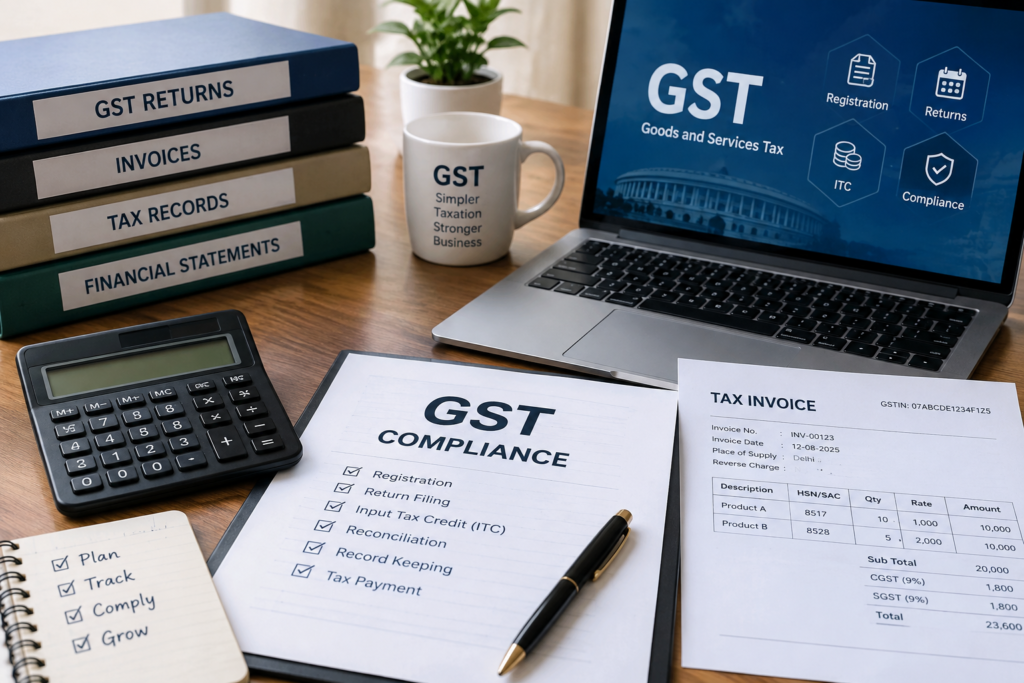
Registered taxpayers must file periodic GST returns, which include details of sales, purchases, tax collected, and tax paid. Common returns include:

  • GSTR-1 (Outward supplies)
  • GSTR-3B (Monthly summary return)
  • Annual return

Timely filing of returns is essential to avoid penalties and ensure smooth business operations.

Benefits of GST

GST has brought several advantages to the Indian economy:

  • Simplified Tax Structure: Replaced multiple indirect taxes with a single system
  • Elimination of Cascading Effect: Reduced double taxation
  • Ease of Doing Business: Simplified compliance through online systems
  • Uniform Tax Rates: Created a common market across states
  • Increased Transparency: Improved tax compliance and reduced evasion

GST has also encouraged digitization and formalization of the economy.

Challenges under GST

Despite its benefits, GST has faced certain challenges:

  • Complex compliance for small businesses
  • Frequent changes in rules and rates
  • Technical issues with the GST portal
  • Working capital blockage due to delayed ITC refunds

The government continues to address these issues through policy updates and system improvements.

GST for Small Businesses

To support small businesses, the government introduced the Composition Scheme. Under this scheme, eligible businesses can pay GST at a lower fixed rate and file simplified returns. However, they cannot claim input tax credit.

This scheme reduces the compliance burden for small taxpayers and encourages voluntary registration.

GST and Digital Economy

GST has significantly contributed to the digital transformation of India’s tax system. The entire process—from registration to return filing—is conducted online. This has increased efficiency, reduced corruption, and improved record-keeping.

E-invoicing and e-way bills are additional features that enhance transparency and tracking of goods movement.

Importance of GST for Businesses

GST plays a crucial role in business operations:

  • Ensures legal compliance
  • Improves supply chain efficiency
  • Reduces tax costs through ITC
  • Enhances credibility with customers and vendors
  • Facilitates expansion across states

Understanding GST is essential for businesses to remain competitive and compliant.

Conclusion

GST has revolutionized the indirect tax system in India by creating a unified, transparent, and efficient tax structure. While challenges remain, continuous reforms and technological advancements are making GST more business-friendly.

For entrepreneurs, professionals, and businesses, staying updated with GST laws and compliance requirements is essential. A well-managed GST system not only ensures legal compliance but also contributes to long-term business growth and sustainability.


GST (Goods and Services Tax) – Complete Guide (India)

GST (Goods and Services Tax) – Complete Guide (India)

Goods and Services Tax (GST) is one of the most significant tax reforms in India, introduced to unify the country’s indirect tax system. It replaced multiple cascading taxes like VAT, service tax, excise duty, and others with a single, comprehensive tax structure. GST aims to create a transparent, efficient, and business-friendly tax regime that simplifies compliance and promotes economic growth.

GST was implemented on 1st July 2017 through the Goods and Services Tax Act, 2017, marking a major transformation in India’s taxation system.

What is GST?

GST is a destination-based indirect tax levied on the supply of goods and services. It is charged at every stage of the supply chain, but the final burden is borne by the end consumer. Businesses can claim input tax credit (ITC) on taxes paid at earlier stages, eliminating the cascading effect of taxes.

Objectives of GST

  • One nation, one tax system
  • Eliminate cascading taxes
  • Increase tax compliance
  • Promote ease of doing business
  • Boost economic growth
  • Create a unified national market

Structure of GST in India

GST in India follows a dual model:

  1. CGST (Central GST) – Collected by the Central Government
  2. SGST (State GST) – Collected by State Governments
  3. IGST (Integrated GST) – Levied on inter-state transactions
  4. UTGST (Union Territory GST) – Applicable in Union Territories

This structure ensures proper distribution of tax revenue between the center and states.

Types of GST Rates

GST is divided into multiple tax slabs:

  • 0% – Essential goods (like fresh food)
  • 5% – Basic necessities
  • 12% and 18% – Standard goods and services
  • 28% – Luxury and sin goods

The rates vary depending on the nature of goods and services.

Key Features of GST

  • Destination-based taxation
  • Input Tax Credit mechanism
  • Online compliance system
  • Transparency in taxation
  • Reduction in tax evasion
  • Simplified tax structure

Input Tax Credit (ITC)

One of the most important features of GST is ITC. Businesses can claim credit for the tax paid on purchases and offset it against their output tax liability. This reduces the overall tax burden and avoids double taxation.

GST Registration

Businesses must register under GST if their turnover exceeds the prescribed threshold (generally ₹20 lakh or ₹40 lakh, depending on the type of business and state). Registration is mandatory for:

  • Interstate suppliers
  • E-commerce sellers
  • Service providers above threshold
  • Casual taxable persons

GSTIN (GST Identification Number)

Every registered taxpayer receives a unique GSTIN, which is used for filing returns, paying taxes, and tracking transactions.

GST Return Filing

GST requires regular filing of returns to report sales, purchases, and tax liability. Common returns include:

  • GSTR-1 (Outward supplies)
  • GSTR-3B (Summary return)
  • GSTR-9 (Annual return)

Timely filing is essential to avoid penalties.

Composition Scheme

Small businesses can opt for the composition scheme, which allows them to pay tax at a fixed rate with reduced compliance requirements. However, they cannot claim input tax credit under this scheme.

Advantages of GST

  • Simplifies the tax system
  • Reduces compliance burden
  • Eliminates cascading taxes
  • Encourages transparency
  • Boosts exports (zero-rated)
  • Improves logistics and supply chain efficiency

Challenges of GST

  • Initial implementation issues
  • Frequent changes in rules
  • Compliance burden for small businesses
  • Technical glitches in the portal
  • Complexity in certain sectors

Impact of GST on Economy

GST has significantly impacted the Indian economy by:

  • Increasing tax base
  • Improving revenue collection
  • Promoting formalization of businesses
  • Reducing logistics costs
  • Enhancing ease of doing business

GST Council

The GST Council is the governing body responsible for making decisions related to GST rates, rules, and policies. It includes representatives from the central and state governments.

E-Way Bill System

The e-way bill is required for movement of goods above a certain value. It ensures transparency and prevents tax evasion during transportation.

GST Compliance and Penalties

Non-compliance with GST provisions can result in penalties, interest, and legal action. Businesses must maintain proper records and file returns on time to avoid issues.

Future of GST in India

GST continues to evolve with reforms aimed at simplifying procedures and improving efficiency. The government is working on reducing compliance burdens and enhancing digital infrastructure.

Conclusion

GST has revolutionized India’s indirect tax system by creating a unified and transparent framework. Despite initial challenges, it has brought significant improvements in tax administration and economic growth. Understanding GST is essential for businesses and individuals to ensure compliance and take advantage of its benefits.


Navigating Compliance: A Complete Guide to GST Registration and Return Filing

Navigating Compliance: A Complete Guide to GST Registration and Return Filing

The Goods and Services Tax (GST) has transformed India’s indirect tax system by unifying multiple taxes into a single, transparent structure. Introduced in 2017, GST has simplified tax administration, increased compliance, and made business operations more efficient. However, for every business, understanding GST registration and return filing is essential to ensure legal compliance and avoid penalties.


1. Understanding GST Registration

GST registration is the first step for any business operating under the GST regime. It assigns a unique Goods and Services Tax Identification Number (GSTIN) to every registered taxpayer, enabling the collection and remittance of GST to the government.

Who Needs to Register Under GST?

  • Businesses with an annual turnover exceeding ₹40 lakhs (₹20 lakhs for service providers).

  • E-commerce operators and online sellers.

  • Inter-state suppliers of goods or services.

  • Agents or distributors acting on behalf of other taxpayers.

  • Input Service Distributors (ISDs) and non-resident taxable persons.

Benefits of GST Registration:

  • Legally recognized as a supplier of goods and services.

  • Ability to collect GST from customers and claim Input Tax Credit (ITC).

  • Enhances business credibility and enables participation in interstate trade.


2. The GST Registration Process

The registration process is conducted entirely online through the GST portal (www.gst.gov.in).

Steps include:

  1. Visit the GST Portal – Click on ‘New Registration’.

  2. Provide Basic Details – Such as PAN, mobile number, and email ID.

  3. Verification – Receive OTPs on registered contact details for authentication.

  4. Business Details – Fill in business address, partners/directors’ information, and upload documents.

  5. ARN Generation – After submission, an Application Reference Number (ARN) is generated.

  6. GSTIN Allotment – Once verified, the GSTIN and certificate of registration are issued.


3. Understanding GST Returns

Once registered, businesses are required to file GST returns — periodic statements containing details of sales, purchases, tax collected, and tax paid. Filing returns ensures transparency and helps the government track tax flow.

Common GST Returns:

  • GSTR-1: Details of outward supplies (sales).

  • GSTR-3B: Summary return of sales, purchases, and tax liabilities (monthly).

  • GSTR-9: Annual return summarizing all monthly/quarterly filings.

  • GSTR-4: Return for composition scheme taxpayers.


4. Due Dates and Compliance

Timely filing is critical to maintain compliance. Missing deadlines can result in late fees, interest, and even suspension of GSTIN.

  • GSTR-1: 11th of the following month (for monthly filers).

  • GSTR-3B: 20th of the following month.

  • GSTR-9: 31st December of the following financial year.

Businesses must also reconcile invoices and ensure that input credits match the supplier’s uploaded data to avoid mismatches.


5. Importance of Timely and Accurate Filing

Accurate filing helps businesses:

  • Claim eligible Input Tax Credit (ITC) without disputes.

  • Avoid penalties and compliance notices.

  • Maintain a good compliance rating, improving trust with clients and authorities.

  • Contribute to a transparent and robust tax ecosystem.


6. Common Challenges and Practical Tips

Challenges:

  • Frequent changes in GST rules and updates.

  • Complexity in reconciling ITC and vendor data.

  • Technical errors or delays in portal access.

Tips for Smooth Compliance:

  • Use reliable GST accounting software.

  • Maintain updated records of invoices and ledgers.

  • Stay informed about due dates and regulatory updates.

  • Consult a qualified tax professional for complex filings.


Conclusion

GST registration and return filing are more than just regulatory obligations — they are integral to maintaining business transparency and legal credibility. With digital compliance tools and growing awareness, businesses can now navigate GST compliance with greater ease. By understanding and following the right procedures, enterprises not only