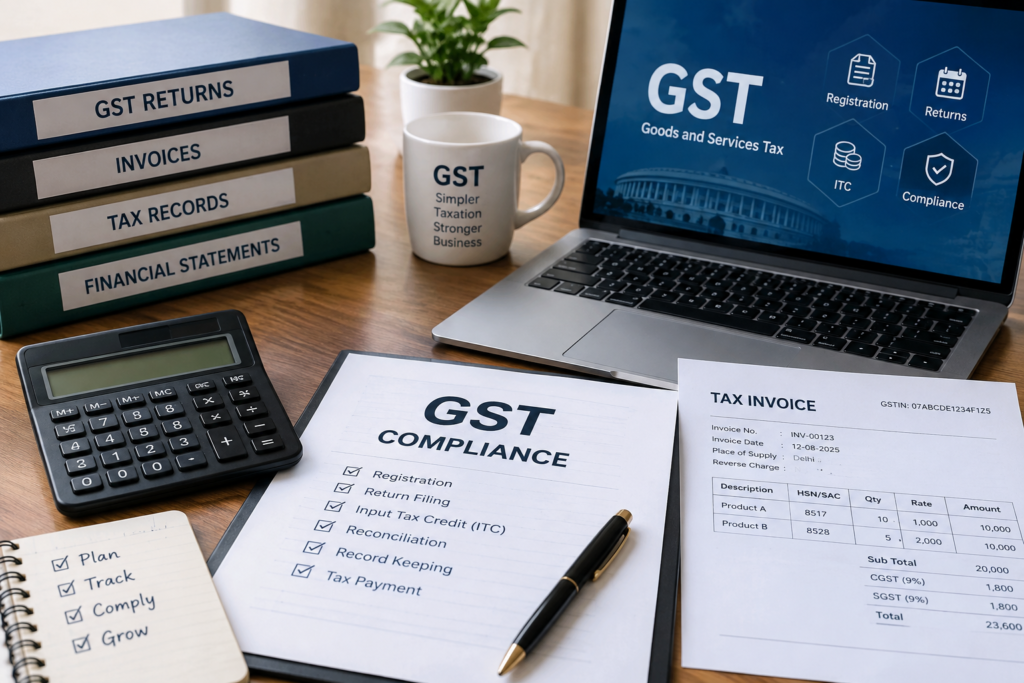
GST (Goods and Services Tax)

GST (Goods and Services Tax)


GST, or Goods and Services Tax, is one of the most significant tax reforms in India. It is a unified indirect tax system introduced to replace multiple indirect taxes such as VAT, service tax, excise duty, and entry tax. GST was implemented to create a single national market, simplify tax compliance, and improve transparency in the taxation system.

In India, GST was introduced on 1 July 2017 under the Goods and Services Tax Act, 2017 and is administered by the Goods and Services Tax Council along with the Central Board of Indirect Taxes and Customs and state tax authorities.

GST applies to the supply of goods and services across the country and has transformed the way businesses manage taxation and compliance.

## What is GST?

GST is a destination-based tax levied on the consumption of goods and services. It means the tax is collected where the goods or services are consumed rather than where they are produced.

It is charged at every stage of the supply chain, but businesses can claim input tax credit for the tax already paid. This avoids the problem of double taxation and reduces the cascading effect of taxes.

GST applies to manufacturers, traders, service providers, e-commerce businesses, and professionals depending on turnover and business activities.

## Types of GST

India follows a dual GST model with different types of GST depending on the nature of the transaction.

### CGST (Central Goods and Services Tax)

CGST is collected by the Central Government on intra-state transactions.

### SGST (State Goods and Services Tax)

SGST is collected by the State Government on the same intra-state transaction.

### IGST (Integrated Goods and Services Tax)

IGST applies to inter-state transactions and imports. It is collected by the Central Government.

### UTGST (Union Territory Goods and Services Tax)

UTGST applies in Union Territories without a legislature.

This structure ensures proper sharing of tax revenue between the central and state governments.

## GST Registration

Businesses whose turnover exceeds the prescribed threshold must register under GST.

GST registration is also required for:

* Interstate suppliers
* E-commerce sellers
* Input service distributors
* Casual taxable persons
* Non-resident taxable persons
* Businesses under reverse charge mechanism
* Certain professionals and service providers

GST registration provides a unique GSTIN (Goods and Services Tax Identification Number) used for tax compliance.

## GST Return Filing

Registered taxpayers must file GST returns regularly.

Common GST returns include:

* GSTR-1 for outward supplies
* GSTR-3B for monthly summary returns
* GSTR-9 for annual return
* GSTR-9C for reconciliation statement in applicable cases

Timely return filing is necessary to avoid late fees, penalties, and compliance notices.

## Input Tax Credit (ITC)

Input Tax Credit is one of the biggest advantages of GST.

It allows businesses to claim credit for the GST paid on purchases used for business purposes. This reduces the final tax burden and improves cash flow.

For example, if a manufacturer pays GST on raw materials, that amount can be adjusted against the GST payable on final product sales.

Proper invoice matching and compliance are necessary for claiming ITC.

## Benefits of GST

GST offers several benefits for businesses and the economy.

### Simplified Tax Structure

It replaces multiple taxes with one unified system.

### Reduced Tax Burden

Input tax credit reduces cascading taxes and overall cost.

### Better Compliance

Digital registration, return filing, and payment systems improve transparency.

### Increased Business Efficiency

Uniform taxation improves interstate trade and business operations.

### Economic Growth

GST supports formalization of the economy and improves tax collection.

## Common GST Issues

Businesses often face challenges such as:

* Registration delays
* Incorrect tax classification
* ITC mismatch
* Late return filing
* GST notices
* Refund delays
* Reverse charge confusion
* E-invoicing compliance issues

Professional guidance helps businesses handle these issues effectively.

## GST Penalties

Non-compliance with GST rules can lead to serious penalties.

Examples include:

* Late filing fees
* Interest on delayed payments
* Penalty for non-registration
* Penalty for false invoicing
* Tax demand notices
* Cancellation of GST registration
* Business audits and investigations

Regular compliance is necessary to avoid financial and legal risks.

## Role of GST Professionals

Chartered accountants, tax consultants, and legal advisors help businesses with:

* GST registration
* Return filing
* Input tax credit management
* GST audits
* Notice handling
* Refund claims
* Litigation and appeals
* Tax planning and advisory

Professional support ensures smooth compliance and reduces legal exposure.

## Conclusion

GST has changed the Indian taxation system by creating a more transparent, efficient, and unified structure for indirect taxes. It benefits businesses through simplified compliance, better tax credit systems, and smoother interstate trade.

However, proper understanding of GST laws, registration requirements, return filing, and compliance responsibilities is essential for avoiding penalties and ensuring business success. Whether for small businesses, startups, or large corporations, GST compliance is a critical part of financial management and legal responsibility.


Income Tax in India: A Complete Guide for Individuals and Businesses (2026)

Income Tax in India: A Complete Guide for Individuals and Businesses (2026)


Income tax is one of the most important components of a country’s financial system. In India, it serves as a primary source of revenue for the government, funding infrastructure, public services, welfare schemes, and national development. For individuals, professionals, and businesses, understanding income tax is essential for compliance, financial planning, and avoiding legal complications.

Governed by the Income Tax Act, 1961, income tax in India is administered by the Income Tax Department. Over the years, tax laws have evolved to simplify compliance, increase transparency, and promote digital filing systems.

What is Income Tax?

Income tax is a direct tax levied by the government on the income earned by individuals, companies, and other entities during a financial year. It is calculated based on predefined tax slabs and rates, depending on income level, age, and category of taxpayer.

The tax collected is used to fund essential services such as healthcare, education, defense, and infrastructure development, making it a crucial tool for economic growth.

Types of Income Under Income Tax

Income in India is classified into five major heads:

1. Income from Salary
Includes wages, bonuses, pensions, and allowances received from employment.

2. Income from House Property
Income earned from renting or leasing property.

3. Profits and Gains from Business or Profession
Income generated from business activities, freelancing, or professional services.

4. Capital Gains
Profit from the sale of assets like property, shares, or mutual funds.

5. Income from Other Sources
Includes interest income, dividends, gifts, and winnings from lotteries.

Understanding these categories helps taxpayers accurately calculate their total taxable income.

Income Tax Slabs in India (2026)

India follows a progressive tax system where tax rates increase with income. Taxpayers can choose between the old tax regime (with deductions) and the new tax regime (with lower rates but fewer deductions).

Old Tax Regime:
Allows deductions under sections like 80C, 80D, and others.

New Tax Regime:
Offers lower tax rates but removes most exemptions and deductions.

Choosing the right regime depends on individual financial planning and investment strategies.

Deductions and Exemptions

Deductions play a key role in reducing taxable income:

  • Section 80C: Investments in PPF, LIC, ELSS, etc.
  • Section 80D: Health insurance premiums
  • Section 24: Home loan interest
  • HRA and LTA exemptions
  • Education loan interest under Section 80E

Proper use of deductions can significantly lower tax liability.

Filing Income Tax Returns (ITR)

Filing an Income Tax Return is mandatory for individuals whose income exceeds the basic exemption limit. It is done online through the official portal of the Income Tax Department.

Steps involved:

  • Calculate total income
  • Apply deductions and exemptions
  • Determine tax liability
  • Pay tax (if applicable)
  • File return online
  • Verify the return

Timely filing ensures compliance and avoids penalties.

Importance of PAN and Aadhaar

A Permanent Account Number (PAN) is essential for all tax-related transactions. It is linked with Aadhaar to streamline the tax process and prevent fraud.

PAN is required for:

  • Filing tax returns
  • Opening bank accounts
  • High-value transactions
  • Investment activities

Linking PAN with Aadhaar has become mandatory for seamless processing.

Advance Tax and TDS

Tax Deducted at Source (TDS):
Tax is deducted by the payer before making certain payments like salary or interest.

Advance Tax:
Tax paid in installments during the financial year if liability exceeds a specified limit.

These mechanisms ensure steady revenue flow to the government and reduce the burden on taxpayers at year-end.

Penalties for Non-Compliance

Failure to comply with income tax rules can lead to penalties:

  • Late filing fees
  • Interest on unpaid tax
  • Notices from tax authorities
  • Legal action in serious cases

Timely compliance helps avoid unnecessary legal and financial stress.

Tax Planning vs Tax Evasion

Tax planning involves legally reducing tax liability using deductions and exemptions. Tax evasion, on the other hand, involves illegal practices such as hiding income or falsifying records.

The Income Tax Department actively monitors transactions to detect evasion. Ethical tax planning is always recommended.

Benefits of Paying Income Tax

Paying income tax is not just a legal obligation—it also offers several benefits:

  • Contributes to national development
  • Enables access to financial services like loans and visas
  • Builds financial credibility
  • Supports government welfare programs

It plays a crucial role in building a responsible and transparent economy.

Digital Transformation in Taxation

India has made significant progress in digital tax administration:

  • Online ITR filing
  • Faceless assessments
  • E-verification of returns
  • AI-based fraud detection

These advancements have simplified the tax process and reduced human intervention.

Common Mistakes to Avoid

Many taxpayers make errors that can lead to penalties:

  • Incorrect income reporting
  • Missing deadlines
  • Claiming ineligible deductions
  • Not verifying returns
  • Ignoring tax notices

Being careful and informed can prevent such issues.

Tips for Effective Tax Management

  • Maintain proper financial records
  • Plan investments early
  • Choose the right tax regime
  • Consult tax professionals if needed
  • Stay updated with tax laws

Smart tax planning can help maximize savings and ensure compliance.

Final Thoughts

Income tax is a vital part of India’s economic structure, impacting individuals, businesses, and the nation as a whole. Understanding how it works—from income classification and tax slabs to deductions and filing procedures—can help taxpayers manage their finances more effectively.

With increasing digitization and simplified processes, complying with tax laws has become easier than ever. By staying informed, planning wisely, and adhering to legal requirements, taxpayers can not only avoid penalties but also contribute meaningfully to the country’s growth.

Income Tax: A Comprehensive Guide for Individuals and Businesses in India

Income Tax in India: Complete Guide to Tax Slabs, Filing Process, Deductions & Legal Compliance


Income tax is one of the most significant sources of revenue for the government and plays a vital role in the economic development of a country. In India, income tax is governed by the Income Tax Act, 1961, and is administered by the Income Tax Department under the Ministry of Finance. Whether you are a salaried individual, a business owner, or a freelancer, understanding income tax is essential for financial planning, compliance, and avoiding legal complications.

What is Income Tax?

Income tax is a direct tax that is levied on the income earned by individuals, Hindu Undivided Families (HUFs), companies, firms, and other entities. The tax is calculated based on the income earned during a financial year (April 1 to March 31) and is paid in the assessment year that follows.

Types of Income Tax in India

Income in India is categorized under five heads:

  1. Income from Salary – Includes wages, pensions, gratuity, bonuses, and other allowances.
  2. Income from House Property – Rental income from owned property.
  3. Profits and Gains from Business or Profession – Income earned from business activities or professional services.
  4. Capital Gains – Profit from the sale of assets like property, shares, or mutual funds.
  5. Income from Other Sources – Interest income, dividends, lottery winnings, etc.

Income Tax Slabs (New vs Old Regime)

The Indian government provides two tax regimes:

Old Tax Regime

Offers various deductions and exemptions such as:

  • Section 80C (Investments like LIC, PPF, ELSS)
  • HRA (House Rent Allowance)
  • Medical Insurance (80D)

New Tax Regime

Introduced to simplify taxation with lower tax rates but fewer deductions.

Taxpayers can choose the regime that benefits them the most.

Importance of Filing Income Tax Returns (ITR)

Filing Income Tax Returns is mandatory if your income exceeds the basic exemption limit. It is also important for:

  • Claiming tax refunds
  • Applying for loans and visas
  • Avoiding penalties and legal notices
  • Maintaining financial records

Deductions and Exemptions

Some popular deductions include:

  • Section 80C: Up to ₹1.5 lakh (PPF, EPF, LIC, ELSS)
  • Section 80D: Health insurance premiums
  • Section 24(b): Interest on home loan
  • Section 10(13A): HRA exemption

Using these deductions can significantly reduce taxable income.

TDS (Tax Deducted at Source)

TDS is a system where tax is deducted at the source of income. For example, employers deduct TDS on salary, and banks deduct TDS on interest income. It ensures steady tax collection and reduces the burden at year-end.

Advance Tax

If your total tax liability exceeds ₹10,000 in a financial year, you are required to pay advance tax in installments. This is especially applicable to freelancers, business owners, and professionals.

Penalties for Non-Compliance

Failure to comply with income tax regulations can result in:

  • Late filing fees (up to ₹5,000 or more)
  • Interest on unpaid taxes
  • Notices from the Income Tax Department
  • Legal consequences in severe cases

Digital Transformation in Income Tax

The Indian government has made significant efforts to digitize tax processes:

  • Online ITR filing
  • Pre-filled forms
  • Faceless assessments
  • E-verification via Aadhaar OTP

These steps have made compliance easier and more transparent.

Tax Planning vs Tax Evasion

It is important to understand the difference:

  • Tax Planning: Legal way to minimize tax liability using deductions and exemptions.
  • Tax Evasion: Illegal method to avoid paying taxes, punishable by law.

Smart tax planning helps individuals save money while staying compliant.

Income Tax for Businesses

Businesses must maintain proper books of accounts, file returns regularly, and comply with GST and other regulations. Corporate tax rates vary depending on turnover and type of company.

Startups may also avail tax benefits under certain government schemes.

Role of a Tax Consultant

Hiring a tax consultant or chartered accountant can help:

  • Optimize tax savings
  • Ensure compliance
  • Handle notices and assessments
  • Provide financial planning advice

Conclusion

Income tax is not just a legal obligation but a contribution towards nation-building. Understanding the fundamentals of income tax, filing returns on time, and making use of available deductions can help individuals and businesses stay financially healthy and legally compliant. With increasing digitalization, the process has become simpler, making it easier for taxpayers to fulfill their responsibilities efficiently.